Search Focus Are A SEO Company That Can Increase Your Online Sales Revenue Through Driving Qualified Targeted Visitors To Your Website
Google Ads Quality Score Optimisation Guide
A low Quality Score can quietly drain a Google Ads budget. No drama. No obvious warning. Just higher click costs, weaker ad visibility and fewer enquiries from the same spend.
I approach Quality Score in a very practical way because I work with websites, search intent, landing pages and lead generation every week. At Wigan SEO, based in Wigan, Greater Manchester, I have spent 24 years improving websites and search campaigns for UK businesses, and one pattern keeps appearing: paid search performance is rarely only about bids. The page, the wording, the intent and the tracking all matter.
Quality Score is not a trophy metric. It is a diagnostic signal inside Google Ads that helps show whether your keyword, advert and landing page make sense together. When they don’t, you usually pay for the mismatch.
What Google Ads Quality Score Actually Measures
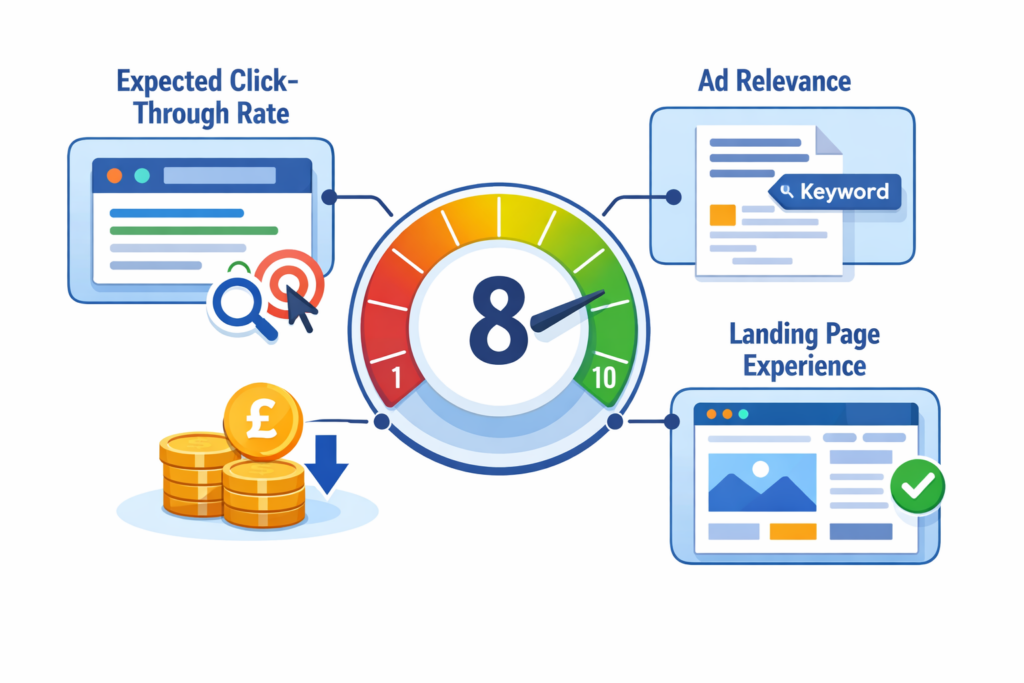
Google Ads Quality Score is shown as a number from 1 to 10 at keyword level. A score of 1 is poor. A score of 10 is strong. The number is based on Google’s view of how useful and relevant your ad and landing page are likely to be for someone searching that keyword.
Three areas feed into it:
| Quality Score factor | What it checks | What usually improves it |
|---|---|---|
| Expected click-through rate | How likely your ad is to be clicked for the keyword | Sharper ad copy, better intent matching, cleaner keyword groups |
| Ad relevance | How closely your advert matches the search term | Specific headlines, tighter ad groups, fewer mixed-intent keywords |
| Landing page experience | Whether the destination page is useful, relevant and easy to use | Clear content, fast loading, mobile usability, strong conversion paths |
The visible Quality Score is a diagnostic estimate. It is not the same thing as the live auction calculation used every time someone searches. Google’s auction also considers bids, ad assets, context, competitiveness and other real-time signals. Still, a poor Quality Score is usually a useful warning that the campaign has friction somewhere.
That friction costs money.
Why Quality Score Affects Cost And Visibility
Google Ads uses Ad Rank to decide whether ads show and where they appear. Ad Rank is influenced by bid amount, auction-time ad quality, expected impact from ad assets, thresholds, competition and the search context. In simple terms, a better quality advert can compete more efficiently than a weak one with the same bid.
This is why two advertisers can bid on the same keyword and get different outcomes. One may have a highly relevant advert, a useful landing page and strong engagement history. The other may send every click to a generic home page. The second advertiser often has to compensate with higher bids.
For small UK businesses, this matters because wasted clicks add up quickly. A campaign does not need to be huge to leak money. If the advert promises emergency boiler repairs but the page talks mainly about new installations, the user has to work too hard. Many won’t.
If you need help with paid search structure, landing pages and campaign performance, my Google Ads management support is built around enquiries, not vanity metrics.
The Preparation Guide Before You Optimise
Rushing into Quality Score changes can make reporting messy. Before altering keywords, ads or pages, I like to prepare the account properly. It avoids guesswork and makes it easier to see whether the work improved anything.
What to check first:
- Keyword Quality Score, expected CTR, ad relevance and landing page experience columns.
- Search terms that triggered clicks in the last 30 to 90 days.
- Conversion actions, call tracking, forms and key events.
- Landing page speed, mobile layout and message match.
- Campaign settings, locations, bidding strategy and budgets.
- Whether brand, competitor and service keywords are separated.
Safety considerations:
Do not change everything at once. Big edits can reset useful learning signals, muddy the data and make performance harder to interpret. If a campaign is already generating enquiries, protect what works before testing new versions.
Privacy matters too. UK advertisers should think carefully about consent, cookies, tracking tags and personal data. This is general guidance rather than legal advice, but if you are tracking form submissions, phone calls or remarketing audiences, check that your setup is appropriate for your business and current UK privacy expectations.
Tools and materials:
- Google Ads keyword and search terms reports.
- Google Analytics 4 reports.
- Google Tag Manager, if used.
- A spreadsheet for keyword mapping.
- Landing page access, especially WordPress access if the site uses Elementor, Divi or WPBakery.
- A list of real services, locations, prices, guarantees and conversion goals.
Good tracking is essential. If conversions are not recorded correctly, you may optimise towards cheaper clicks instead of better leads. I normally recommend checking GA4 event tracking setup before making major bidding decisions.
Preparation steps:
- Export current keyword scores and performance data.
- Mark the date before making changes.
- Group keywords by intent, not just topic.
- Identify the worst scores with meaningful spend.
- Check whether low scores are caused by ads, keywords or landing pages.
- Create a test plan for the next 14 to 30 days.
Main Instructions: A Practical Quality Score Audit
Step 1: Start with expensive low-score keywords.
Do not waste time polishing keywords with no impressions and no spend. The first area I would check is the keyword list sorted by cost, then Quality Score. A keyword with a score of 3 and £4 of spend is not urgent. A keyword with a score of 4 and hundreds of pounds of spend needs attention.
Step 2: Check intent before changing bids.
Some keywords look relevant but attract the wrong searcher. “Boiler cost” could mean research, comparison, DIY curiosity or a serious purchase enquiry. “Boiler installation Wigan quote” is more commercial. Same broad topic. Very different intent.
Step 3: Split mixed ad groups.
A common issue I see in business accounts is one ad group trying to cover too much. Repairs, servicing, installations, emergency work and finance offers all sit together. The advert then becomes vague because it has to serve every keyword at once.
Specific usually wins.
Step 4: Match the landing page to the promise.
If the advert headline says “Emergency Garage Door Repairs”, the page should quickly confirm emergency repairs, service area, response expectations, contact options and trust signals. Sending users to a general garage doors page may work sometimes, but it usually weakens relevance.
Step 5: Record the before-and-after data.
Quality Score changes can take time to appear because Google needs enough impression data. Look at trends rather than one-day swings. CTR, conversion rate, cost per conversion and search term quality matter as much as the score itself.
Improving Expected Click-Through Rate
Expected CTR is Google’s prediction of how likely people are to click your advert when the keyword triggers it. You improve it by making the advert more compelling and more relevant to the search.
Use the searcher’s language.
If people search for “accountant for self assessment”, do not write only “professional financial services”. Use plain commercial language. The closer the advert reflects the problem, the easier the click becomes.
Write headlines with intent built in.
Weak headline: “Quality Local Services”.
Stronger headline: “Bathroom Fitter In Wigan”.
Even stronger: “Wigan Bathroom Fitter Quotes”.
The strongest version depends on the keyword, the offer and whether the landing page supports it. Avoid stuffing the same phrase into every headline. It reads badly and can reduce trust.
Use assets properly.
Sitelinks, callouts, structured snippets, location assets and call assets can make ads more useful. They also increase the visible size of the advert. For a local service business, useful callouts might include “Free Quotes”, “Local Wigan Team”, “Emergency Appointments” or “Fully Insured” — but only if those claims are true.
Remove weak searches.
Negative keywords are often the fastest way to improve CTR. If your paid ad appears for “jobs”, “free”, “template”, “DIY”, “manual” or “course” searches, people may ignore it. That damages performance and wastes budget.
Improving Ad Relevance
Ad relevance measures how closely the advert matches the keyword. A broad, generic advert tends to perform poorly because it does not feel written for the specific search.
Build tighter ad groups.
One of the mistakes I regularly encounter is using the same advert for several services. A roofer might have one ad group covering flat roofs, slate roofs, roof repairs, chimney repairs and guttering. The advert then says “Roofing Services”, which is true but not specific enough.
A better structure would separate each major service. That allows a roof repair advert to talk about roof repairs, not general roofing. It also lets the landing page align more closely.
Use match types carefully.
Broad match can be powerful when conversion data is strong and negative keywords are maintained. It can also open the door to irrelevant searches if the account is immature. Phrase and exact match often give more control, especially for smaller budgets.
I do not treat one match type as universally best. The correct solution depends on budget, conversion volume, industry, location and how carefully the account is monitored.
Keep brand terms separate.
Brand searches often have high CTR and strong relevance because the searcher already knows the business. Mixing brand terms with non-brand service keywords can make campaign performance look healthier than it really is. Keep them separate so decisions are cleaner.
Improving Landing Page Experience
Landing page experience is where SEO, website development and paid search meet. A strong advert can only do so much if the destination page is slow, thin, confusing or mismatched.
From reviewing and improving websites over many years, I have found that many PPC problems start on the page rather than inside Google Ads. The advert gets blamed. The real issue is often the content.
Match the page to the keyword.
If a keyword targets “commercial electrician Manchester”, the page should make it clear that commercial electrical work in Manchester is available. It should not force the visitor to infer it from a generic electrical services page.
Make the first screen useful.
On mobile, the top of the page has to work hard. It should show the service, location relevance, main benefit and a clear action. A huge decorative image, vague slogan and hidden phone number can damage both conversion performance and user satisfaction.
Use content that answers buying questions.
Visitors often want to know what you do, where you work, whether you handle their specific problem, how to contact you, what happens next and why they should trust you. Paid traffic is impatient. Make answers easy to find.
For local campaigns, strong organic content principles still apply. The way website content affects rankings is closely related to how well a landing page satisfies intent: relevance, clarity and usefulness all matter.
Improve speed and usability.
A slow landing page can lose visitors before they even read the offer. Compress heavy images, reduce unnecessary scripts, check Core Web Vitals where possible and test the page on a real phone, not just a desktop preview.
If visitors arrive and leave almost immediately, review layout, load speed and message match. My practical notes on how to reduce bounce rate properly are useful when PPC landing pages attract clicks but fail to hold attention.
Search Terms And Negative Keywords
The search terms report is where the truth appears. Keywords are what you bid on. Search terms are what people actually typed.
Check this report regularly, especially when using broad match or automated bidding. You may find searches that are too informational, too cheap to convert, outside your service area or completely unrelated. Add negatives carefully. Do not block useful variations by accident.
Common negative keyword themes:
- Employment searches such as jobs, careers, salary and apprenticeship.
- Free research searches such as template, PDF, sample and guide.
- DIY intent such as how to, parts, manual and instructions.
- Wrong locations where the business cannot serve the customer.
- Low-fit products or services the business does not offer.
Negative keywords are not a one-off job. Search behaviour changes. Competitors change their wording. Google’s matching systems change too. A clean search terms report today can become messy again in a few weeks.
Common Quality Score Problems And Fast Fixes
Problem: Quality Score is stuck at 3 or 4.
Likely causes: The keyword may be too broad, the advert may be generic or the landing page may not answer the search properly. Sometimes the account simply lacks enough recent impressions for the score to move quickly.
Fastest solution: Focus on the highest-spend affected keyword. Create a tighter ad group, write more specific ads and send traffic to the most relevant page available.
How to fix it properly: Map the keyword to one clear intent. Remove unrelated search terms. Improve the page heading, opening copy, service detail, location signals and calls to action. Then monitor performance over the next few weeks.
Signs of a more serious problem: Low Quality Score across most non-brand keywords, poor conversion rates, high bounce rates and search terms that do not match the business. That suggests the issue is structural, not isolated.
How to prevent it: Build campaigns around intent from the start. Keep services separated. Use dedicated pages where the commercial value justifies them.
Problem: CTR drops after adding new keywords.
Likely causes: The new keywords may be broader than expected, ads may not mention the specific service, or impressions may be coming from weaker locations, devices or search terms.
Fastest solution: Pause the worst new keywords temporarily and review the search terms report.
How to fix it properly: Add negatives, refine match types and create new adverts for the added intent. If the keyword deserves its own page, do not force it into an existing one just because it is convenient.
Signs of a more serious problem: Spend rises but conversions stay flat. That usually means traffic quality has deteriorated.
How to prevent it: Add new keyword groups in controlled batches. Label them. Measure them separately.
Problem: Landing page experience is below average.
Likely causes: The page may be slow, thin, hard to use on mobile, lacking trust signals or poorly matched to the advert. Tracking scripts, pop-ups and bloated page builders can also affect usability.
Fastest solution: Improve the visible top section: service name, location, main benefit, phone number and enquiry button. Then test the page on mobile.
How to fix it properly: Rewrite the page around search intent, improve internal structure, compress media, remove distractions and make forms easier. If the page is built in WordPress, check whether unnecessary plugins or builder elements are slowing it down.
Signs of a more serious problem: Several landing pages perform badly, organic rankings are weak and analytics shows poor engagement. That may indicate wider technical or content issues.
How to prevent it: Review pages before launching ads. Connect PPC planning with website content and SEO planning rather than treating them as separate worlds.
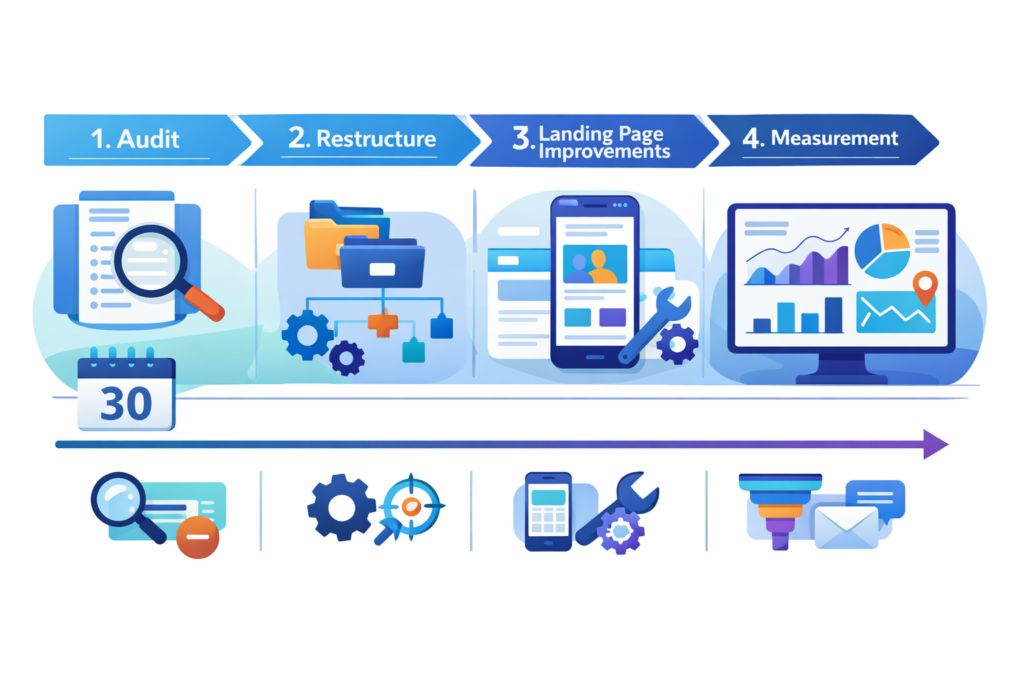
A 30-Day Quality Score Optimisation Sprint
Days 1 to 3: Audit and prioritise.
Export keyword data. Highlight low Quality Score keywords with meaningful spend. Check conversion tracking and search terms. Make sure you know which campaigns genuinely produce enquiries.
Days 4 to 7: Restructure the worst ad groups.
Split mixed services into tighter groups. Rewrite adverts so headlines and descriptions clearly match the keyword intent. Add useful assets where they are missing.
Days 8 to 14: Improve landing pages.
Work on the pages used by the highest-spend keywords first. Improve the first screen, service detail, proof points, mobile layout and calls to action. Do not redesign for decoration. Redesign for clarity.
Days 15 to 21: Clean search terms.
Add negative keywords. Adjust match types if poor searches keep appearing. Check whether location targeting is too wide. For service-area businesses, wasted location clicks can be surprisingly expensive.
Days 22 to 30: Measure and refine.
Compare CTR, conversion rate, cost per conversion and Quality Score movement. Use reporting carefully. If you need cleaner dashboards, GA4 reporting and data visualisation can help separate useful trends from noise.
Some scores will move quickly. Others won’t. That does not always mean the work failed. Look at commercial performance as well as the visible number.
Quality Score Benchmarks: What Is Good Enough?
A score of 7 or above is usually healthy. A score of 10 is excellent, but chasing 10 on every keyword can become a distraction. Some competitive or unusual keywords may never reach the top score, especially if search intent is mixed.
I normally treat scores like this:
| Score range | How I would read it | Priority |
|---|---|---|
| 1 to 3 | Serious relevance or experience issue | High if spending money |
| 4 to 5 | Weak and probably inefficient | Medium to high |
| 6 | Acceptable but improvable | Review if volume is strong |
| 7 to 8 | Generally healthy | Maintain and test |
| 9 to 10 | Very strong diagnostic signal | Protect performance |
The priority is not the score alone. A low-score keyword with high spend and poor conversion rate is urgent. A low-score keyword with tiny spend and no strategic value can wait.
Measuring The Results Without Fooling Yourself
Quality Score optimisation should be judged by business outcomes. Lower CPC is useful, but not if lead quality falls. Higher CTR is useful, but not if it attracts people who never buy.
Track:
- Click-through rate.
- Average CPC.
- Conversion rate.
- Cost per enquiry or sale.
- Search term quality.
- Lead quality, where it can be checked.
- Landing page engagement.
For local businesses, I also pay close attention to phone calls and form enquiries. Rankings and clicks are nice, but the commercial question is simpler: did the right people get in touch?
Attribution will never be perfect. Someone may click an ad, compare your business, return through organic search and then call. Treat data as evidence, not absolute truth. The best decisions usually combine platform data, analytics, enquiry quality and common sense.
Mistakes That Quietly Damage Quality Score
Sending every advert to the home page.
The home page is rarely the best PPC landing page unless the brand is the search intent. Service keywords usually need service pages.
Using one campaign for everything.
When services, locations and intent types are all mixed together, budgets become hard to control and ad relevance suffers.
Ignoring mobile users.
Many service enquiries happen on phones. If the phone number is hard to tap or the form is awkward, performance drops.
Writing adverts before checking the page.
An advert should not promise what the page cannot support. If the page does not mention finance, emergency work, same-day appointments or a location, be careful about putting those claims in the ad.
Optimising for Google Ads only.
A good landing page can support PPC, SEO and conversions together. A weak one hurts all three. When working on SEO campaigns for UK businesses, I have seen better results when the website structure, content and paid search message are planned together rather than patched separately later.
Final Thoughts From A Freelancer’s Perspective
Quality Score optimisation is not about gaming Google. It is about making the journey cleaner: search term, keyword, advert, landing page and enquiry. When those pieces line up, campaigns usually become easier to manage and less wasteful.
The best starting point is simple. Find where the money is being spent, check whether the searcher’s intent is being served, and improve the weakest link first. Sometimes that means rewriting adverts. Sometimes it means rebuilding a landing page. Sometimes it means cutting poor searches that should never have entered the account.
No responsible freelancer can promise a fixed CPC, a guaranteed Quality Score or a certain number of leads. Results depend on competition, budget, website condition, offer strength and how well tracking is configured. But a careful, structured approach gives you a much better chance of paying for useful clicks instead of expensive guesswork.
Small improvements compound. That is where the value is.